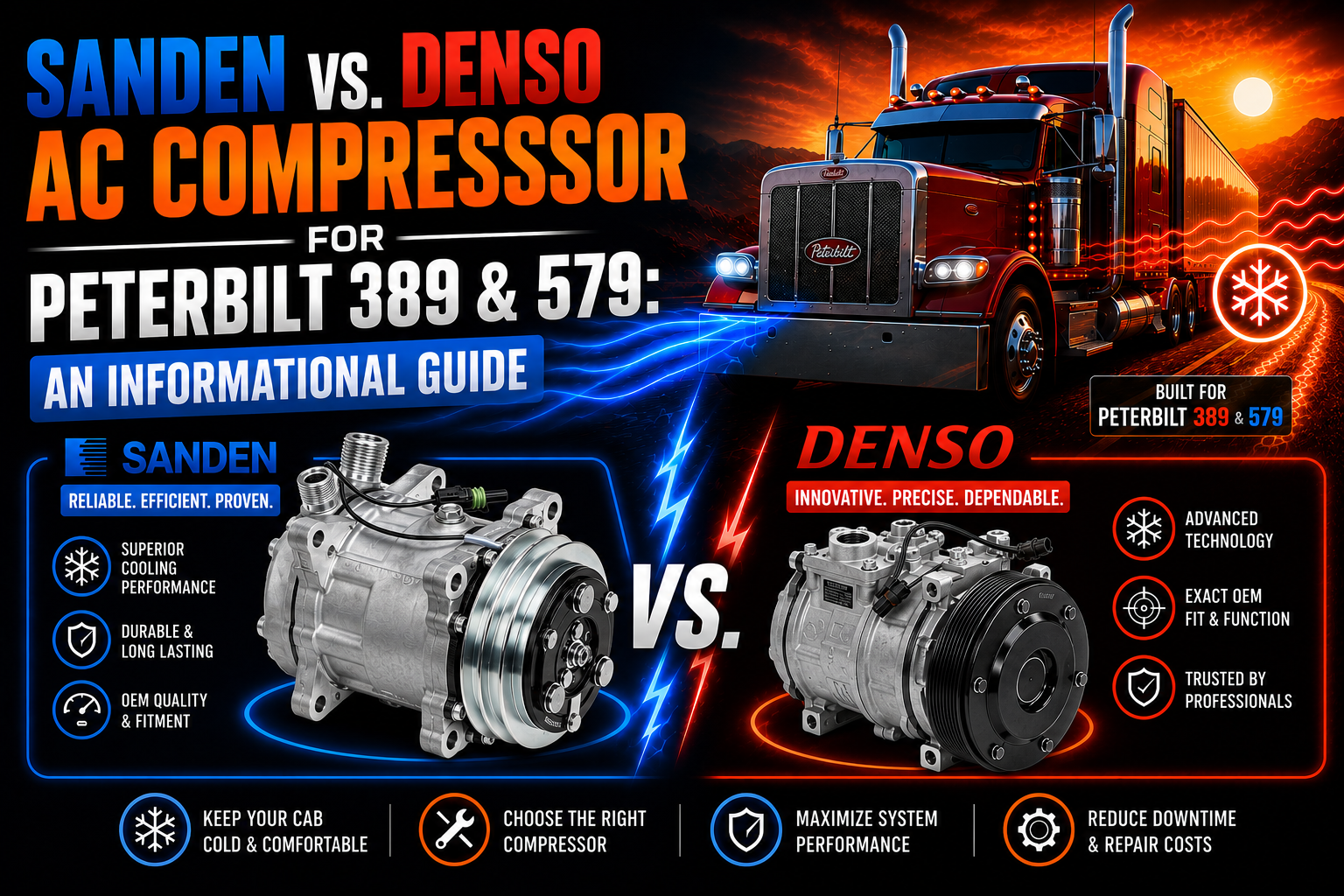
If you're looking into AC compressors for your Peterbilt 389 or 579, you've probably already come across two names over and over: Sanden and Denso. That's not a coincidence. Both companies are established OEM suppliers to the heavy-duty truck industry, and both have earned their reputation the hard way — by building compressors that hold up in real working conditions, mile after mile.
This guide walks through where each brand shows up on the 389 and 579, what makes each one a solid choice, and how to figure out which compressor your truck actually uses. Whether you're doing a routine replacement or just want to understand your AC system better, this should give you a clear picture.
Why Sanden and Denso Are Both OEM Standards
Peterbilt has sourced compressors from both Sanden and Denso across different model years, engine configurations, and cab spec packages for the 389 and 579. That's a deliberate engineering choice, not a cost-cutting shortcut. Both manufacturers meet the performance and durability standards required for heavy-duty trucking, and both have long track records supplying compressors to major truck and equipment makers well beyond Peterbilt.
In practice, this means there's no "downgrade" option between the two. If your truck came from the factory with a Sanden unit, it was speced that way because Sanden built the right compressor for that configuration. Same goes for Denso. The right compressor for your truck is the one that matches your original spec — and here, both brands deliver.
Sanden Compressors on the 389 and 579
Sanden has supplied compressors to Peterbilt for decades and remains one of the most common OEM units found across both the 389 and 579 lineups. A few things stand out about Sanden's presence on these trucks:
Long-standing OEM relationship. Sanden's history with Peterbilt means brackets, pulleys, and mounting hardware are engineered specifically around their compressor housings on many trim levels, which makes for a clean factory fit.
Widespread use across configurations. You'll find Sanden compressors on a broad range of 389 and 579 builds, from standard day cabs to sleeper configurations, which speaks to their versatility across different cooling demands.
Strong aftermarket support. Because Sanden has been a mainstay in the heavy-duty market for so long, parts, rebuild kits, and full replacement units are well stocked through most truck parts channels.
Take a look at the full Sanden compressor lineup to see which units are available for your specific 389 or 579 configuration.
Denso Compressors on the 389 and 579
Denso brings a similar level of OEM credibility to the table, with a manufacturing pedigree that spans automotive, heavy-duty truck, and industrial equipment applications. On the 389 and 579, Denso compressors show up in a number of configurations, particularly where smooth, quiet operation is a priority.
Engineering focus on ride quality. Denso's compressor designs, including variable displacement models, are built to modulate output smoothly rather than cycling hard on and off. That's part of why Denso units are often associated with quieter cab operation, something drivers notice especially at idle or during overnight bunk AC use.
OEM presence across sleeper cab builds. Denso compressors are frequently found on 579 sleeper configurations and 389 builds where extended idle time and driver comfort systems are part of the spec.
Reliable engineering standards. Denso's global reputation as a Tier 1 automotive and heavy-duty supplier reflects rigorous manufacturing standards, which is a big part of why Peterbilt continues to spec Denso units across select model years.
Browse the Denso compressor catalog to find the right match for your truck's configuration.
How to Tell Which Compressor Your Truck Has
The most reliable way to identify your compressor is to check the part number stamped on the unit itself or pull it from your build sheet using your VIN. Compressor spec can vary by:
-
Model year
-
Engine option
-
Cab configuration (day cab vs. sleeper)
-
Bunk AC or APU equipment
Rather than assuming based on brand preference, cross-reference your VIN or existing compressor part number with the compressor listings for Peterbilt trucks to confirm you're looking at the correct replacement.
Side-by-Side Overview
|
Factor |
Sanden |
Denso |
|
OEM relationship with Peterbilt |
Long-standing, widely specced |
Established, widely specced |
|
Common applications |
Day cab and sleeper configurations |
Sleeper cabs, bunk AC/APU-equipped trucks |
|
Known for |
Broad compatibility, deep parts availability |
Smooth, quiet operation at idle |
|
Aftermarket support |
Extensive |
Strong, growing |
|
Design approach |
Proven fixed and variable displacement designs |
Emphasis on variable displacement smoothness |
Both brands meet OEM specifications for the 389 and 579, and both are backed by decades of heavy-duty engineering experience. The differences here are about design emphasis, not about one brand outperforming the other in a general sense.
Installation Basics
Replacing a compressor on a 389 or 579, whether it's a Sanden or Denso unit, generally follows the same core process:
-
Recover refrigerant properly before disconnecting any lines
-
Remove the serpentine belt and unbolt the compressor from its mounting bracket
-
Transfer or replace the clutch assembly as needed
-
Replace the receiver-drier or accumulator as part of the service, which helps protect the new compressor and keep the system running clean
-
Evacuate and recharge the system to spec
-
Verify clutch engagement and confirm proper cooling performance under load
If you're matching a like-for-like replacement, bracket and pulley fitment will typically line up without modification since both brands are built to OEM spec for their respective applications.
Choosing Between Sanden and Denso
Since both brands meet the same OEM standard, the decision often comes down to matching your truck's original configuration and thinking about your specific operating conditions:
Sanden tends to be a strong fit if:
-
You're doing a like-for-like replacement on a truck that came from the factory with a Sanden unit
-
You want the widest possible selection of parts and rebuild options
-
Your truck runs a mix of day cab and standard highway duty cycles
Denso tends to be a strong fit if:
-
Your truck runs heavy overnight idle time with bunk AC or an APU system
-
Quiet cab operation is a priority for driver comfort
-
Your truck came factory-equipped with a Denso unit and you're keeping the original spec
Either way, the safest approach is matching your replacement to the original equipment your truck was built with, since Peterbilt engineers each configuration around a specific compressor spec.
The Bottom Line
Sanden and Denso have each earned their place as trusted OEM compressor suppliers for the Peterbilt 389 and 579. Neither is a compromise choice. Both reflect decades of engineering investment in heavy-duty cooling systems, and both continue to be specced by Peterbilt for good reason.
When it's time to replace your compressor, the goal is simple: match your truck's original configuration and make sure the receiver-drier or accumulator gets replaced alongside it for a clean, reliable install.
Explore current part numbers and availability for your configuration at Peterbilt AC compressor parts to find the right fit for your truck.
This guide reflects general OEM application patterns across the Peterbilt 389 and 579 platforms. Always confirm exact part numbers against your truck's VIN before ordering.
Disclaimer: This article is provided for general informational purposes only and is not intended as a complete maintenance, repair, or diagnostic guide. Always verify procedures and specifications using the applicable OEM service information and consult a qualified service professional before performing any work. TruckAC+ assumes no liability for actions taken based on this content.