Your AC compressor is the heart of your truck's cooling system. When it's working right, you barely think about it. When it fails on a July afternoon somewhere outside Amarillo, it's suddenly the only thing you think about.
Here's something a lot of truck owners don't realize until they're standing in front of a parts counter, sweating: not all compressors are built the same way. Under the hood, there are a few fundamentally different designs doing the same job—compressing refrigerant so your cab stays livable—but they go about it in different ways, with different strengths, weaknesses, and failure points.
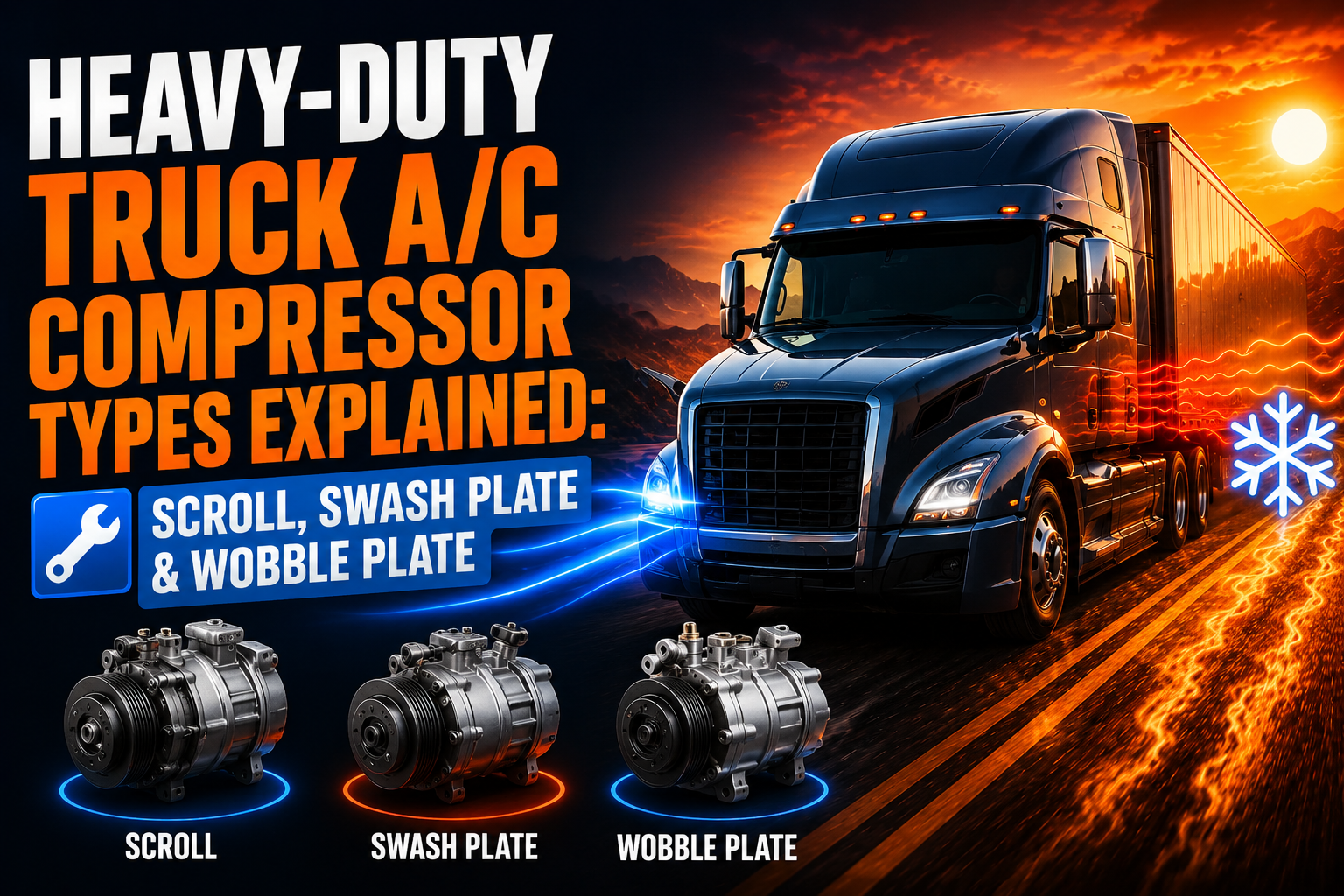
Knowing which type is in your truck (and why it was chosen for that application) changes how you think about maintenance, what questions to ask a technician, and how you shop for a replacement. So let's walk through the three main designs you'll run into on heavy-duty trucks: scroll, swash plate, and wobble plate compressors.
Why Compressor Type Actually Matters
Before we get into the specifics, it's worth answering the obvious question: does this actually affect me, or is it just engineering trivia?
It matters more than most people expect. Compressor type affects:
-
How the compressor handles heat and pressure under long idle times or stop-and-go city routes
-
Noise and vibration, especially in cabs where the compressor sits close to the driver
-
Serviceability—some designs are easier and cheaper to rebuild than others
-
Longevity under heavy-duty cycles, which is a different animal than passenger car AC use
A compressor that's perfect for a delivery van doing short hops around town might not hold up the same way in a long-haul rig running 10+ hours a day in triple-digit heat. That's the whole reason multiple designs exist in the first place—each one trades off differently between simplicity, durability, and performance.
Scroll Compressors: Smooth, Quiet, and Increasingly Common
How they work
Picture two interlocking spiral-shaped scrolls, one fixed and one orbiting around it (not spinning—orbiting, like a coin wobbling flat on a table before it settles). As the orbiting scroll moves, it traps refrigerant gas between the two spirals and squeezes it toward the center, where pressure builds and the gas gets pushed out to the rest of the AC system.
There are no pistons slamming back and forth here. No valves clacking open and shut. Just a smooth, continuous squeezing motion.
When they're used
Scroll compressors started in passenger cars and have been steadily working their way into medium-duty and some heavy-duty truck applications, particularly where cab comfort and noise reduction are priorities. You'll also find them in auxiliary and sleeper cab AC units, where a quiet compressor matters a lot more when someone's trying to sleep six feet away from it.
Pros
-
Quiet and smooth operation—fewer moving parts means less vibration and noise
-
Consistent performance across a wide range of speeds
-
Fewer parts to wear out compared to piston-based designs
Cons
-
Less common in traditional heavy-duty trucks, so parts availability can be more limited depending on your make and model
-
More sensitive to contamination—debris or moisture in the system can cause problems faster than in more rugged piston designs
-
Repair often means replacement—scroll units are typically harder to rebuild in the field compared to swash or wobble plate compressors
Swash Plate Compressors: The Workhorse of the Industry
How they work
A swash plate is basically an angled disc mounted on a rotating shaft. As the shaft spins, the angled plate wobbles the pistons arranged around it in and out, compressing refrigerant with each stroke. Multiple pistons fire in sequence, which keeps the whole thing running relatively smooth despite being a piston-driven design.
Think of it like a mechanical assembly line: the swash plate keeps pushing pistons through their compression stroke one after another, in a continuous rhythm.
When they're used
This is the design you'll find in the vast majority of heavy-duty trucks on the road today. It's the go-to choice for OEMs because it strikes a good balance between durability, output, and cost. If you're driving a Class 8 truck, there's a solid chance a swash plate compressor is doing the work under your hood right now.
Pros
-
Proven and widely used—decades of real-world heavy-duty use back this design up
-
Good balance of power and efficiency, handling high AC demand well
-
Parts and rebuild kits are widely available, since it's the industry standard
Cons
-
More moving parts than a scroll compressor, which means more potential wear points over time
-
Can be louder than scroll designs, especially as components age
-
Heavier, which matters in some weight-sensitive applications
Wobble Plate Compressors: Efficient and Built for Variable Loads
How they work
Wobble plate compressors are close cousins to swash plate designs, and people sometimes use the terms loosely, but there's a real distinction. In a wobble plate design, the plate itself doesn't rotate with the shaft—it "wobbles" while staying in a fixed rotational position, driving the pistons through a slightly different mechanical linkage. This setup often allows for variable displacement, meaning the compressor can adjust its output based on how much cooling is actually needed at any given moment.
When they're used
You'll find wobble plate compressors in applications where variable-capacity cooling is valuable—trucks that spend a lot of time idling, running through varied climates, or operating in stop-and-go conditions where constant full-output cooling would waste fuel and put unnecessary wear on the system.
Pros
-
Variable displacement capability means better efficiency across different driving conditions
-
Can reduce fuel consumption since the compressor isn't always running at full capacity
-
Good match for trucks with unpredictable duty cycles, like regional delivery or mixed-route fleets
Cons
-
More complex internally, which can mean higher rebuild or replacement costs
-
Fewer aftermarket options compared to standard swash plate units
-
Diagnosing issues can be trickier due to the variable displacement mechanism
So Which One Do You Actually Have—And Does It Matter for Replacement?
If you're not sure which type is currently in your truck, that's completely normal—most drivers don't think about it until something breaks. The good news is your VIN, make, model, and year will tell a parts specialist exactly what you're working with, and matching the correct compressor type (not just a compressor that "fits") is what keeps your AC system running the way it's supposed to.
Swapping a swash plate design for a wobble plate unit, or trying to force a scroll compressor into an application built for something else, isn't a simple bolt-on decision. Mounting points, drive mechanisms, and system pressures are all tuned to the original design. Getting this wrong doesn't just cause a bad AC day—it can lead to premature failure, refrigerant leaks, or damage to other parts of the system.
If you're dealing with a compressor that's on its way out, or you just want to understand your options before something goes wrong, it's worth browsing through the range of heavy-duty truck AC compressors available so you know what fits your specific rig before you're stuck making a decision under pressure—literally and figuratively.
Whichever design your truck runs, the goal is the same: reliable cooling, mile after mile, without surprises. Understanding what's actually spinning, orbiting, or wobbling under that housing is a good first step toward keeping it that way.
Disclaimer: This article is provided for general informational purposes only and is not intended as a complete maintenance, repair, or diagnostic guide. Always verify procedures and specifications using the applicable OEM service information and consult a qualified service professional before performing any work. TruckAC+ assumes no liability for actions taken based on this content.